Notes
originally published in 1986 by Grey Editions, Bristol
Publisher Note
“Along with many, if not most, of my friends, I was unemployed in the early 1980s. There were no jobs to speak of, and none to be found. Claiming unemployment benefit required that you attend the local Department of Employment office in person to sign paperwork in front of them confirming you were unemployed. As the number of people without work increased dramatically, the queues to ‘sign on’ lengthened, then lengthened again. Waiting times moved into hours, mornings, afternoons, then whole days. Scheduled interview appointments meant waiting beside a partitioned cubicle to be summoned, or for a staff member to randomly appear. It took a long while for me to realise precisely what it was I was witnessing here: these offices were where political ideology and citizens’ lives collided.
In early 1980’s Britain, workers became poker chips in a strategic game, as Margaret Thatcher enacted an agenda to reshape British society, abandoning the ‘postwar consensus’ and asserting the political class as the sole arbiter of power. Her ruling Conservative government forced through policies privatising state industries, engaging in direct confrontation with the unions, and redefining the UK’s social and economic priorities.
Thatcher triumphed on all fronts — major industries like steel, coal, and the railways were sold off to corporate interests at a discount, and union power was vanquished as an effective counterweight. The main weapon was the threat of mass unemployment. Never overtly stated, it was the bludgeon that hung over every negotiation, every worker, every regular life. The consequence of this radical agenda was literally millions of unemployed, sluiced into an unprepared Department of Employment, and Department of Social Services, who never got the memo, and weren’t supposed to, anyway.
This had to be recorded, be photographed, and as nobody else was doing it, it fell to me. I visited offices in Liverpool and Manchester, Birmingham and Bristol (where I was signed on, Plate 6, with the woman in a headscarf) and London (including Lisson Grove, Plate 4, my office after moving to the capital). The queues and waits were long, and grew longer, the ennui of powerlessness, a constant. People of every kind appeared — younger, older, male, female, middle management, teachers, professionals, blue collar, and highly educated. There were some who had health issues or addictions or personality problems, but equally there were many for whom the fact of being unemployed created these issues – being thrown onto the scrapheap mid-life, and effectively told your experience and skills had no merit or value, was utterly destabilizing. What kind of country does that to its own citizens?
~~~~
The fact that these images are taken directly from life is a vital but thorny issue here, one that often comes up and needs responding to, and of course, as the maker of them, I am not insensitive to the inherent difficulties. To be clear, discretion was only required from the staff and occasional security guard, rather than the public. There was no hidden or secret camera – I used a ‘medium format’ Plaubel, which is certainly not quiet or small, and took many images in each office – the point being: most people central to the images knew what was happening. That said, in very crowded offices, asking each and every person was impossible, and ultimately one had to balance a decision of potential good against potential harm. If you proceed, you try to act ethically with the images, not to place them in a stock photo agency or sell them to random publications, not to allow biased captioning. Small mercies, I know, but it’s the raindrops that make the ocean.”
- Paul Graham
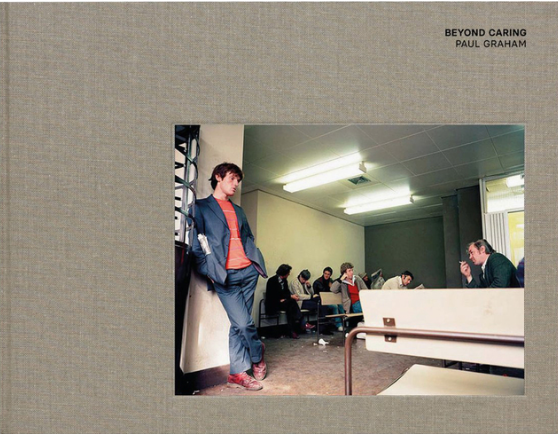
Originally self-published in 1985, Paul Graham’s renowned series, ‘Beyond Caring’, was made in the waiting rooms and corridors of the Social Security and Unemployment offices around the UK, documenting the long waits, queues and poor conditions of an overburdened system, to produce a powerful series of photographs conveying the hardship people experienced.
Denied official permission to make the work, Graham’s photographs were taken discreetly, usually without looking through the camera, resulting in a spatial disorientation that emphasised the unmoored distress of vulnerable citizens.
The work shocked many on its release – leading Magnum photographers were outraged by its use of colour in a classic documentary topic, while others celebrated how it straddled the world of activism and art (it was exhibited at both Trade Union conferences and the Museum of Modern Art, New York).
Graham forged a fresh form of engaged photography, mixing elements of social documentary, ‘new colour’ and reportage to create a striking body of work that endures to this day.
| Publisher | |
|---|---|
| Edition | 2nd edition |
| Release Date | 2021 |
| Credits |
Artist:
|
| Identifiers |
ISBN-13:
9781913620127
|
| Work | |
|---|---|
| Subform | Photography |
| Topics | Unemployment; |
| Language | English |
| Object | |
|---|---|
| Dimensions | 32.2 × 24.3 cm |
| Interior | |
|---|---|
| Pages | 84 |