Notes
1. edition: 2001
Publisher Note
“Can you combine justice with forgiveness?”
In April 1996 an extraordinary process began in South Africa. The Truth and Reconciliation Commission, under its chairman Archbishop Desmond Tutu, held its first public hearings to investigate over thirty years of human rights violations under apartheid.
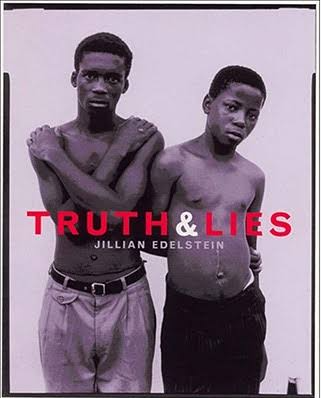
Jillian Edelstein returned to her native South Africa to photograph the work of this committee and was present at some of the most important hearings, including that of Winnie Mandela. In Truth and Lies, portraits of those who testified are accompanied by their stories. The result is a powerful and moving record of the atrocities committed under apartheid and the fight to make the truth known.
The Truth and Reconciliation Commission (TRC) was a court-like restorative justice body assembled in South Africa in 1996 after the end of apartheid. Authorised by Nelson Mandela and chaired by Desmond Tutu, the commission invited witnesses who were identified as victims of gross human rights violations to give statements about their experiences, and selected some for public hearings. Perpetrators of violence could also give testimony and request amnety from both civil and criminal prosecution.
The TRC was based in Cape Town. The hearings started in 1996. The mandate of the commission was to bear witness to, record, and in some cases grant amnesty to the perpetrators of crimes relating to human rights violations, as well as offering reparation and rehabilitation to the victims. A register of reconciliation was also established so that ordinary South Africans who wished to express regret for past failures could also express their remorse.
The work of the TRC was accomplished through three committees:
The Human Rights Violations Committee investigated human rights abuses that occurred between 1960 and 1994.
The Reparation and Rehabilitation Committee was charged with restoring victims' dignity and formulating proposals to assist with rehabilitation.
The Amnesty Committee considered applications from individuals who applied for amnesty in accordance with the provisions of the Act.
The Commission found that there were 7,000 political deaths under Apartheid between 1948 and 1989. 73 of these deaths were in detention while in the hands of the security police. More than 19,050 people had been victims of gross human rights violations. An additional 2,975 victims were identified through the applications for amnesty. In reporting these numbers, the Commission voiced its regret that there was very little overlap of victims between those seeking restitution and those seeking amnesty.
A total of 5,392 amnesty applications were refused, granting only 849 out of the 7,111 (which includes the number of additional categories, such as "withdrawn").
Opinions differ about the efficacy of the restorative justice method (as employed by the Truth and Reconciliation Commission) as compared to the retributive justice method, of which the Nuremberg trials are an example.
The hearings were initially set to be heard in camera, but the intervention of 23 non-governmental organisations eventually succeeded in gaining media access to the hearings. On 15 April 1996, the South African National Broadcaster televised the first two hours of the first human rights violation committee
hearing live. With funding from the Norwegian government, radio continued to broadcast live throughout. Additional high-profile hearings, such as Winnie Mandela’s testimony, were also televised live.
The rest of the hearings were presented on television each Sunday, from April 1996 to June 1998, in hour-long episodes.
Truth & Lies
— Stories from the Truth and Reconciliation Commission in South Africa
by Jillian Edelstein
| Publisher | |
|---|---|
| Release Place | London, United Kingdom |
| Edition | 2nd edition |
| Release Date | 2014 |
| Credits |
Writer:
Artist:
|
| Identifiers |
ISBN-13:
9781862074460
|
| Work | |
|---|---|
| Subform | Photobook |
| Topics | Apartheid, Human Rights, South Africa, Winnie Mandela |
| Methods | Photography |
| Language | English, English |
| Object | |
|---|---|
| Format | Softcover |
| Dimensions | 20.2 × 25.0 cm |
| Interior | |
|---|---|
| Pages | 228 |