Publisher Note
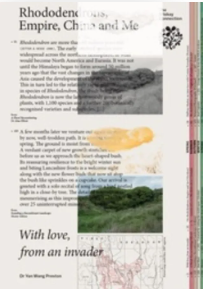
With Love. From an Invader. – Rhododendrons, Empire, China and Me is a love letter to Britain’s most hated non-native invasive plant - the Rhododendron ponticum. Every other day from 17 March 2020 to 16 March 2021, Yan Wang Preston walked and photographed one love-heart-shaped Rhododendron ponticum bush in Burnley, Lancashire. The period also marked the beginning of her intensive study towards this contested habitat and its complex history. The ritual walks offered her time and space to experience, observe, and explore the land from different perspectives. She not only looked, listened, touched, and played, but also used a variety of methods to highlight the ‘invisible’ aspects of the otherwise bare landscape. Her infrared motion-sensitive cameras saw more than 20 different animal species, while her sound recorder heard over 45 different bird species in the area.
Other than observing and documenting, she also selected another tiny rhododendron shrub to have ‘hands on’ interactions. She collected all its fallen leaves in autumn, its seed capsules and aborted flower buds in winter, its fading flowers in spring and summer. This lengthy process of collecting in the field led to further embodiment with the British landscape and enabled Wang Preston to respond subjectively and intuitively to the materials, resulting in a complementary series Autumn Winter Spring Summer.
These Rhododendron ponticum plants are located at the outskirt of Burnley in Lancashire, UK. The plants thrive in this area as a legacy of the local hunting estate during the 19th century, when the plants were grown to provide cover for the game. British rhododendrons are all introduced plants, brought from southern Europe and East Asia for science and horticulture. Once the subject of the “rhodo-craze” in the Victorian era, the plant’s reputation has changed dramatically since the mid-20th century. Although still common and a much-loved sight in most British gardens, one hybrid species, the ponticum variety, is frequently labelled as non-native invasive in conservation management, targeted to be removed with often violent means. For example, Forestry and Land Scotland has ‘used chainsaws, pesticides, and considerable human power to remove this unwelcome alien.’
Certainly not the only species treated this way, the Rhododendron ponticum is a case study for such naturalized hierarchy between the native and the non-native. This unquestioned hatred of the non-native rang alarm for Wang Preston. Like millions of others, she is a migrant in the United Kingdom. The contested perceptions of rhododendrons suggest that politics is at play within the apparent objectivity of science and the definition and ownership of the British landscape. What is a ‘national’ British landscape and its associated ‘national ecology’? Who defines it? And in whose favour? Wang Preston sought to understand both rhododendrons and her own position in this land. What she finds, through the making of With Love. From an Invader. and Autumn Winter Spring Summer, is that the rhododendrons in this area are certainly not invasive. Rather, they are a keystone species that plays a central role in the local ecology.
With Love. From an Invader. celebrates the life and resilience of the rhododendron. The book creates space to contemplate the intimacy, beauty, and strength of nature, and the eternity of time within an ecological and political framework. It is a love letter from a non-native species to the cosmopolitan ecology of contemporary Britain. It is also a love letter to the British land from its non-native inhabitants who make it a home for its multicultural residents, both human and non-human.
Building on from her artworks and field report, the book artfully interweaves 10 essays from leading scholars, curators and local residents, as well as two archival collections from the Royal Botanic Garden Edinburgh. The result is an intimate and multi-layered exploration towards the positive contribution of such non-native species in Britain’s contemporary ecology. Meanwhile, a re-trace of the rhododendron’s colonialism-assisted migration as well as a personal connection between the Chinese-British photographer and the plants help to underpin the potential harmful paring of the two terms ‘non-native’ and ‘invasive’. As a result, the book uses the rhododendrons as a metaphor for human migrants and asks for a more empathetic acceptance for a cosmopolitan natural and cultural ecology without prejudice towards the non-natives.
| Publisher | |
|---|---|
| Edition | 1st edition |
| Release Date | 2025 |
| Credits |
Writer:
Artist:
|
| Printrun | 900 |
| Identifiers |
ISBN-13:
9789493363212
|
| Work | |
|---|---|
| Subform | Photobook |
| Topics | Belonging, Colonial Ecology, Invasion, Rhododendron, Ritual Fieldwork |
| Methods | Photography |
| Language | English |
| Object | |
|---|---|
| Format | Softcover |
| Dimensions | 17.0 × 24.0 cm |
| Interior | |
|---|---|
| Pages | 320 |