Publisher Note
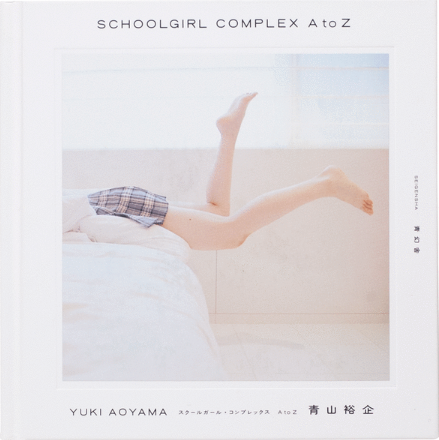
The photobook “Schoolgirl Complex A to Z” contains all 15 “Schoolgirl Complex” series that Yuki Aoyama has created since 2006.
With its straightforward premise based on Aoyama’s fascination with girls in school uniforms which started in his adolescence, the series explores eroticism in innocence and the relationship between symbols, impersonality and individuality. Aoyama’s muted colors and refined compositions allow for an expression of complex emotions, fantasies and desires.
Over the 15 years of the series, as the subject matter evolved from the distance between Aoyama and the girls to the relationship between the girls, the focus shifted to the individuality of the subjects rather than what they symbolize. As a result, the initial rule of “no faces” was gradually removed, and in the end the girls even remove their uniforms and the symbolism which had enwrapped them.
With the change in the series’ subject of interest, Aoyama’s own complex gradually faded away.
“Schoolgirl Complex A to Z” summarizes the entire 15-year long journey of desire, delusion and growing in 500 photographs.
MetalMagazine
“In his work titled “Schoolgirl Complex”, photographer Yuki Aoyama confronts his adolescent fear of girls through a series of images that show the intimacy of schoolgirls in each other’s company. This is, of course, from the perspective of a teenage boy, or rather, the hopeful fantasies of his younger self.
It is, in many ways, inappropriate for a grown man to be obsessing over young girls. In fact, it seems impossible at this point to think of a situation in which this would be at all acceptable. But we have seen it all before. The iconic image of the Japanese schoolgirl has often traversed into Western culture as one of promiscuity and sexual intrigue: take Tarantino’s Kill Bill Volume 1 or Iñárritu’s Babel.
However, Yuki’s almost fetishist portrayal does not show girls with Gogo’s sadistic aggression but rather, girls who are playful, curious and naïve, making it all the more difficult to look at. Without resorting to nudity – his work is not pornography (a clarification that has been made on several occasions) – Yuki manages to depict affection between these girls in an environment in which they are at their most vulnerable: they are at school, in their uniforms, being themselves. Through Yuki’s eyes, it seems as if they are letting him in to their world, allowing him to be a part of what he missed as a teenager, or at least, what he thought he missed. Their interlaced thighs. Their scabbed knees and subtle scars.
More often than not, Yuki forces you into the role of the voyeur, making you feel uncomfortable as if you’re doing something wrong. It makes you wonder what the photographer was like on set while asking his models to pose in scenarios that he had concocted in positions that he had conjured up from the paradigm of the horny teenager within him.
Is he just living out his fantasy under the watered-down pretence of art? Reversing the role of his younger self once intimidated by the presence of the female form, grateful for this newfound confidence. It reaches a level of powerful yet fragile intimacy, challenging you and giving you this strong protective desire to shield the schoolgirls’ innocence from being violated by Yuki’s perverted lens.
| Publisher | |
|---|---|
| Release Place | Kyoto, Japan |
| Edition | 1st edition |
| Release Date | 2021 |
| Credits |
Writer:
Artist:
|
| Identifiers |
ISBN-13:
978-4-86152-856-9
|
| Work | |
|---|---|
| Subform | Photobook |
| Topics | Adolescence, Girls |
| Methods | Photography |
| Language | Japanese |
| Object | |
|---|---|
| Format | Hardcover |
| Dimensions | 17.1 × 17.1 cm |
| Interior | |
|---|---|
| Pages | 512 |