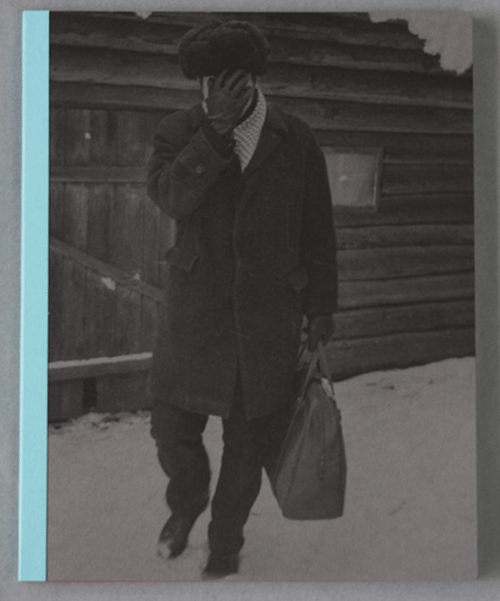
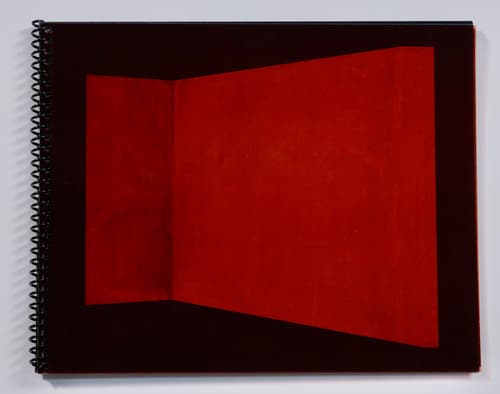
In Volker Renner’s new artist’s book, the focus is not on the monument itself, but on its reproductions. Taken on the Acropolis, the photographs show faded information panels—images of images.
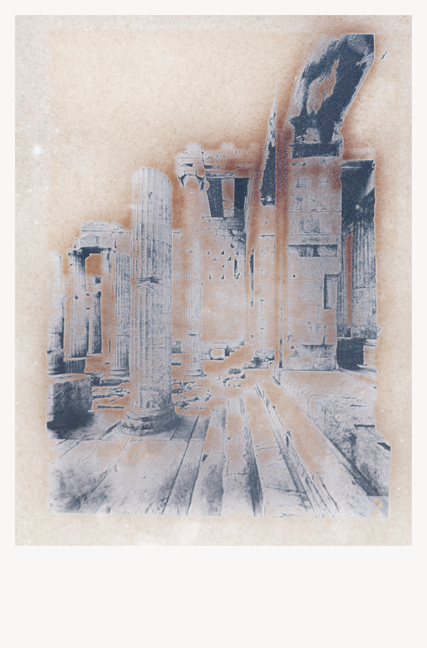
The panels, once intended as didactic mediators between antiquity and the present, have been bleached by the sun. The blue of the Attic sky depicted on them has become little more than a pale echo. Marble columns appear milky, their contours dissolving. The photographs seem displaced in time—not only because they depict historical subjects, but because they themselves have become relics.
Renner does not photograph the Parthenon or the iconic Propylaea, but rather the traces of their mediation. It is a subtle play of layers: ancient architecture documented through photography, reproduced on information panels, and photographed once again. Each layer adds another dimension of time. Every summer, every season of sunlight and tourism inscribes itself as a new patina.
The Acropolis is more than a collection of ancient buildings. It is a symbol of Western cultural history. In the fifth century BC, during the so-called Golden Age of Pericles, the Parthenon was built as a temple dedicated to Athena. Over the centuries, the hill was repeatedly repurposed—as a church, a mosque, and a fortress. Explosions, looting, restoration: every era left its scars.
In the nineteenth century, the Acropolis became a projection surface for the national identity of the newly founded Greek state. An idea of ancient purity was uncovered, while later historical layers were removed—another form of image politics. The notion of a “classical” past remains highly curated to this day.
Renner’s work indirectly connects to this history: his images speak of the continuous process of editing, displaying, and restaging antiquity.
Every year, millions of visitors make their way up the hill. In the summer heat, crowds gather between marble steps and safety railings. Smartphones rise into the air like a second mountain range.
And it is here that a quiet contrast emerges in Renner’s book: while the images on the information panels below are slowly fading, countless new digital images are being produced above. Tourists photograph the Parthenon—perhaps even from the same viewpoints shown on the old panels. Yet their images are high-resolution, instantly shareable, and fleeting within the endless stream of social media.
Renner captures a moment in which visual mediation itself is aging. His photographs do not show the monumental eternity of the Acropolis, but the transience of its representation. The sun becomes a co-author: erasing, overexposing, transforming.
Images That Overtake Themselves
What remains when an image no longer informs? When its colors fade and its legibility begins to disappear?
Renner’s artist’s book does not answer loudly. It shows. It observes. It trusts in the poetic power of fading. The sun-bleached panels appear almost melancholic—like memories that can no longer be fully retrieved.
The result is a multilayered work about time, history, and reproduction. The Acropolis appears not as a static monument, but as a site of continuous overwriting—by history, politics, tourism, and by light itself.